A NATIONAL AWARD

Tuck received a national award at the National Sculpture Society’s annual Awards Dinner in May. The Sculpture House Award recognizes those who contribute to and encourage American sculpture.

Posted in Uncategorized | Leave a comment

MAY NEWSLETTER

INSIDE THE STUDIO

Two weeks looking at art museums in Barcelona and Madrid has Tuck fired up to work in the studio.  Time will tell what new work comes out of the experience.  Meanwhile, he’s finishing up three portraits for Indianapolis and the bases for two annual Pathfinder Awards.

OUT IN PUBLIC

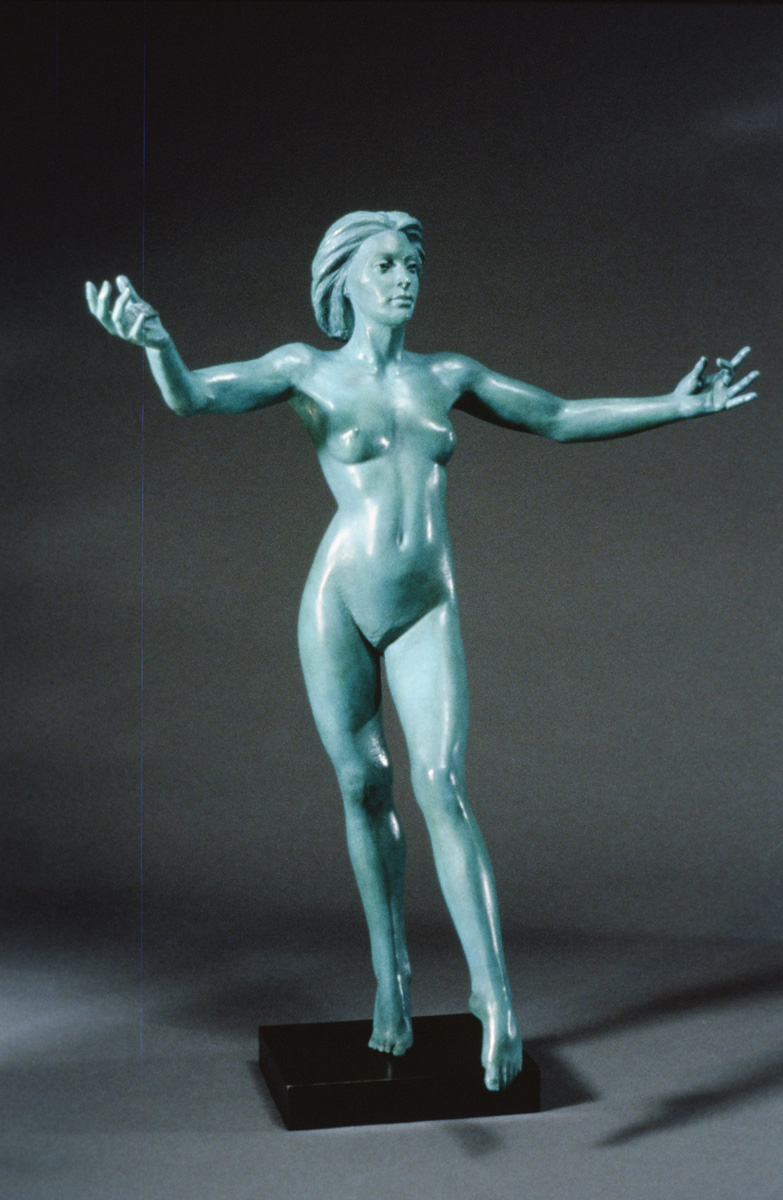
Tuck has a nude figure, Dance of Being, on display at the Tampa Museum of Art.  It is part of the National Sculpture Society’s 80th Annual Awards Exhibition.  As a judge, Tuck was invited to include one of his sculptures, but it is not eligible for a prize.

Dance of Being

Dance of Being

The new Fischoff Grand Prize medal was presented for the first time at the 40th Fischoff Chamber Music Competition in mid-May.  The competition was held in the DeBartolo Performing Arts Center on the campus of The University of Notre Dame.

Posted in Uncategorized | Tagged , , , , | Leave a comment

A Change of Scale

After years of hiring cranes to move his sculptures, Tuck found himself working on sculptures of a completely different scale – those that can be held in one hand.  First he was asked to create 65 small bronze heads as patron gifts for the National Sculpture Society.  Then he was designing two awards.

The Grand Prize Medal for the Fischoff National Chamber Music Competition uses four ribbons to create a visual description of chamber music, where the instruments in an ensemble take turns playing the melody.  One will move forward, then fade into the background while another instrument/ribbon comes forward.

This 3.5″ medal is gold plated bronze.

Gold plated bronze medal

Fischoff Grand Prize Award

Tuck also included ribbons when he designed the new Arthur J. Decio Premier Arts Award.  This small abstract sculpture uses three ribbons to represent the three major parts of theater: music, dance and acting.

Posted in Uncategorized | Leave a comment

FEBRUARY NEWSLETTER

CURRENT MUSEUM SHOWS

“National Academicians: Excellence in American Art and Architecture”
National Academy Museum, New York City
January 31 to May 5, 2013

The National Academy Museum, located on Fifth Avenue in New York City, is hosting a beautiful exhibit of many of America’s top painters, sculptors, graphic artists, photographers and architects. Tuck’s bronze sculpture, Egyptian Princess, is included in that show. The museum is located in the stone mansion once owned by Archer and Anna Hyatt Huntington at 1083 Fifth Avenue, on the same side of the street as the Guggenheim Museum. It is open Wed. to Sun. 11 AM to 6 PM.

“Images of Children in Art, Selections From the Permanent Collection with Special Loans”
Midwest Museum of American Art, Elkhart, Indiana
December 7, 2012 to February 28, 2013

This exhibition of 50 paintings, prints, sculptures, hand-crafted children’s furniture, and toys will end on February 28th. It includes Tuck’s bronze sculpture, African Girl. The Midwest Museum of American Art ithes located at 429 S. Main Street, Elkhart, Indiana.

STUDIO CLASSES & LECTURES
For the next month, Tuck will be teaching a weekly studio class, “From Wax to Bronze” at Fire Arts, a not for profit community studio in downtown South Bend, Indiana.

Tuck will give weekly slide lectures about public sculpture at the Forever Learning Institute at Little Flower Catholic Church in South Bend. His lectures will be a broad survey of sculpture from ancient times to modern.

TODAY’S SMILE

Having completed his design for the Fischoff Chamber Music Competition, Tuck took the wax model to the post office to send it to the foundry.  He was asked the usual questions, like is it liquid, flammable, etc. He said it was just a piece of wax, and it was to be insured for $100. The woman behind him asked how a piece of wax could be worth a hundred dollars. “It depends on the shape of that piece of wax,” he explained. “This is a medal for the Fischoff Competition. Have you ever heard of it?”

“Yes,” she answered. “My husband used to be a professional walleye fisherman, and he went to those events.”

Posted in Uncategorized | Tagged , , | Leave a comment

Abstract vs. Figurative Art by Tuck Langland

When I attend meetings of the International Sculpture Conference, speakers express a strong prejudice against figurative art, and no one seems to question the speaker’s assumptions.  At the National Sculpture Society, which was founded in the 1800s when all sculpture was figurative, figurative art is emphasized in meetings, but abstract is not condemned (conceptual, maybe, but not abstract).  As long as the subject matter is from life, human or animal, the NSS judges it by its artistic quality.  The National Academy ignores subject matter completely, voting both abstract and figurative artists into the organization as Academicians.  They look for the best abstract art, the best figurative art, or professional artists who combine the two.  Art is judged more by its abstract qualities of form, line, balance, and the use of positive and negative space that by its subject matter.  I belong to all three societies.  I was elected into the NA and the NSS, and ISC membership is open to anyone who will pay annual dues.   All three societies are serious and professional.  All three provide valuable information and services for young and emerging artists as well as professionals.

In my mind, all art is an abstraction of reality.  Abstract Art and Figurative Art are not opposites, but they are on two ends of a continuum, and all art, both good and bad, is somewhere along that continuum.  My own art moves back and forth along this continuum, as the sculpture galleries will show you.  When I was young and strongly influenced by Henry Moore, primarily an abstract artist, and Giacomo Manzú, a strongly figurative one, abstract art predominated.  However, during a visit to Manzú’s studio one time, he asked if I would take advice from an old man.  “Beware of nature.  She will trap you.”  I understood exactly what he meant – art is itself an abstraction from what we see in the world, and sculpture of the figure must be something more than taxidermy. What that ‘something more’ is, describes the work of the world’s figurative artists far more than how close they come to the model.

As Vladimir Nabokov once said, “Pay attention to the how, and not the what.”

Posted in Uncategorized | Tagged , | 3 Comments